 tzhouamandClaude Opus 5
c306445ff2
vLLM 0.29 removed AttentionSpec.indexes_kv_by_block_stride and reshaped
KVCacheTensor from (size, shared_by) to an explicit layout: layers in L
order plus layer_stride and block_stride. The block-stride decision now
lives on one physical CacheConfig.kv_cache_layout that the engine core
resolves once, and layout.is_block_outermost is the direct successor of
the old per-spec flag.

Diffusion backends subclass the Omni AttentionBackend ABC, so upstream
get_supported_kv_cache_layouts never sees them and the engine core never
resolves a layout for them. Add diffusion_kv/layout.py to pin it before
get_kv_cache_configs runs, defaulting to LBNHC, which reproduces the
indexes_kv_by_block_stride=False that every dense diffusion backend
declared. The backend hook is kept as an enforced contract rather than
deleted: a backend needing block-stride indexing selects a block-outermost
layout, and a contradiction raises instead of mis-addressing K/V.

Workers receive only a KVCacheConfig, so the resolved name travels on it
(KVCacheConfig.kv_cache_layout) and is adopted into each worker CacheConfig
before allocation. Without that, init_kv_cache raises in the worker because
get_resolved_kv_cache_layout has nothing to return.

init_kv_cache also lost attn_groups and cache_dtype in 0.29; the production
caller in model_runner_backend and the test stubs move to the six-argument
form.

Tensor construction goes through one derivation built on the upstream
compute_layout_strides helper, shared by production and tests, so a wrong
stride cannot be masked by a parallel test-only copy.

Also updates the sizing expectation: 0.29 subtracts the null block that
BlockPool permanently holds back before estimating, so sixteen physical
pages now yield fifteen usable ones.

One review point is addressed only in part, deliberately.
build_native_kv_cache_configs now takes indexes_kv_by_block_stride and
propagates a block-outermost layout end to end when it is set, with a test
covering control plane to worker adoption. Automatic discovery of that
requirement from the workers is not added: 0.29 removed the field that used
to carry it, every diffusion backend in tree declares False, and inventing
an executor RPC for a capability nothing requests would ship untestable
plumbing. Until a backend needs it, the seam is explicit and the mismatch
raises at worker init rather than corrupting addressing.

Co-Authored-By: Claude Opus 5 <noreply@anthropic.com>
Claude-Session: https://claude.ai/code/session_0146Xu5Sgj4vXxLxvLjV5YPj
Signed-off-by: tzhouam <tzhouam@connect.ust.hk>

Easy, fast, and cheap omni-modality model serving for everyone
| Documentation | DeepWiki | User Forum | Developer Slack | WeChat | Paper | Slides |

Latest News 🔥
- [2026/08] We released 0.28.0, featuring production-ready MiniMax H3 serving on GPU and NPU, a unified AR/DiT paged KV cache runtime, and enhanced realtime full-duplex serving for the MiniCPM-o series.
- [2026/08] VeRL-Omni
v0.2.0is released: faster diffusion RL powered by vLLM-Omni (request-level/step-wise batching with FA3), rebuilt Qwen3-Omni multimodal training (DPO & GSPO), plus LTX-2.3, Qwen-Image-Edit support and more. See the release notes. - [2026/08] We released 0.26.0 - aligned with the vLLM 0.26 release line, featuring MiniMax H3 joint video/audio generation, an experimental full-duplex realtime runtime for MiniCPM-o 4.5, distributed layerwise diffusion offload, and broader model, hardware, streaming, TTS, and quantization support.
- [2026/07] We released 0.24.0 - aligned with the vLLM 0.24 release line, expanding production-ready coverage across TTS, speech, diffusion, image/video generation, and robot-policy serving, with major Omni stage runtime refactoring, diffusion request-level batching, async output materialization, quantization/cache/memory improvements, and broad CUDA/ROCm/XPU/NPU support.
- [2026/06] Starting with 0.14.0, vLLM-Omni publishes a stable release aligned with every even-numbered upstream vLLM minor version. 0.16.0, 0.18.0, 0.20.0, and 0.22.0 continued this cadence, expanding omni and world-model support with NVIDIA Cosmos3 and DreamZero, adding models such as MiniCPM-o 4.5, MOSS-TTS, and Lance, and advancing TTS, diffusion, distributed execution, quantization, RL integration through VeRL-Omni, and CUDA/ROCm/MUSA/NPU/XPU coverage.
- [2026/03] Check out our first public project deepdive at the vLLM Hong Kong Meetup!
- [2025/11] vLLM community officially released vllm-project/vllm-omni in order to support omni-modality models serving.
About
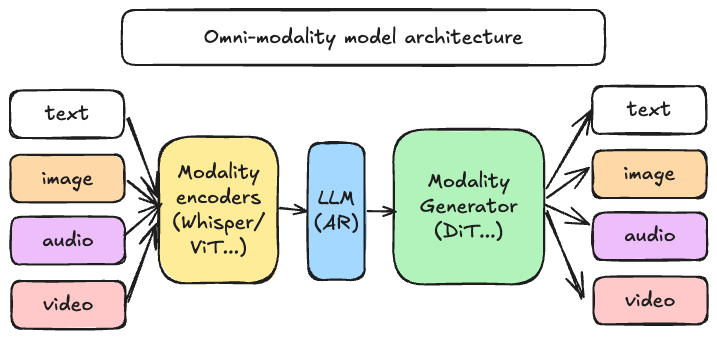
vLLM was originally designed to support large language models for text-based autoregressive generation tasks. vLLM-Omni is a framework that extends its support for omni-modality model inference and serving:
- Omni-modality: Text, image, audio, video, and action data processing
- Non-autoregressive Architectures: extend the AR support of vLLM to Diffusion Transformers (DiT) and other parallel generation models
- Heterogeneous outputs: from traditional text generation to multimodal and action outputs
vLLM-Omni is fast with:
- State-of-the-art AR support by leveraging efficient KV cache management from vLLM
- Pipelined stage execution overlapping for high throughput performance
- Fully disaggregation based on OmniConnector and dynamic resource allocation across stages
vLLM-Omni is flexible and easy to use with:
- Heterogeneous pipeline abstraction to manage complex model workflows
- Seamless integration with popular Hugging Face models
- Tensor, pipeline, data and expert parallelism support for distributed inference
- Streaming outputs
- OpenAI-compatible API server
- Full-duplex realtime serving with streaming audio input and output
vLLM-Omni seamlessly supports most popular open-source models on HuggingFace, including:
- Omni-modality models (e.g. Qwen3-Omni, MiniCPM-o 4.5, Cosmos3, HunyuanImage, BAGEL)
- TTS models (e.g. Qwen3-TTS, IndexTTS 2.5, dots.tts, CosyVoice3)
- Diffusion models — image, video, and audio generation (e.g. MiniMax H3, LTX-2.5, SANA-Video, Wan2.2)
- Robot-policy and action models (e.g. π0, GR00T-N1.7, DreamZero-DROID, InternVLA-A1)
Getting Started
Visit our documentation to learn more.
- Installation
- Quickstart
- Nightly CUDA Docker images built from the latest
main - List of Supported Models
- Deployment Recipes for vLLM-Omni model serving
Contributing
We welcome and value any contributions and collaborations. Please check out Contributing to vLLM-Omni for how to get involved.
Citation
If you use vLLM-Omni for your research, please cite our paper:
@article{yin2026vllmomni,
  title={vLLM-Omni: Fully Disaggregated Serving for Any-to-Any Multimodal Models},
  author={Peiqi Yin, Jiangyun Zhu, Han Gao, Chenguang Zheng, Yongxiang Huang, Taichang Zhou, Ruirui Yang, Weizhi Liu, Weiqing Chen, Canlin Guo, Didan Deng, Zifeng Mo, Cong Wang, James Cheng, Roger Wang, Hongsheng Liu},
  journal={arXiv preprint arXiv:2602.02204},
  year={2026}
}
Join the Community
Feel free to ask questions, provide feedbacks and discuss with fellow users of vLLM-Omni in #sig-omni slack channel at slack.vllm.ai or vLLM user forum at discuss.vllm.ai.
Star History
License
Apache License 2.0, as found in the LICENSE file.