| Documentation | DeepWiki | User Forum | Developer Slack | WeChat | Paper | Slides |
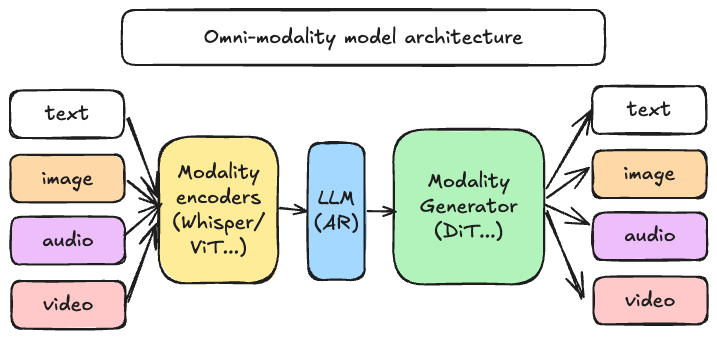
--- *Latest News* 🔥 - [2026/08] We released [0.26.0](https://github.com/vllm-project/vllm-omni/releases/tag/v0.26.0) - aligned with the vLLM 0.26 release line, featuring [MiniMax H3](recipes/MiniMaxAI/MiniMax-H3.md) joint video/audio generation, an experimental full-duplex realtime runtime for [MiniCPM-o 4.5](recipes/OpenBMB/MiniCPM-o-4_5.md), distributed layerwise diffusion offload, and broader model, hardware, streaming, TTS, and quantization support. - [2026/07] We released [0.24.0](https://github.com/vllm-project/vllm-omni/releases/tag/v0.24.0) - aligned with the vLLM 0.24 release line, expanding production-ready coverage across TTS, speech, diffusion, image/video generation, and robot-policy serving, with major Omni stage runtime refactoring, diffusion request-level batching, async output materialization, quantization/cache/memory improvements, and broad CUDA/ROCm/XPU/NPU support. - [2026/06] We released [0.22.0](https://github.com/vllm-project/vllm-omni/releases/tag/v0.22.0) - an **omnimodal world-model** release aligned with vLLM 0.22, featuring [Nvidia Cosmos3](recipes/cosmos3/Cosmos3-Nano.md)/DreamZero world model support, expanded quantization coverage across Blackwell/NPU/XPU, TTS production improvements, new models including MiniCPM-o 4.5, MOSS-TTS, and Lance, plus RL integration with [VeRL-Omni](https://github.com/verl-project/verl-omni). - [2026/05] We released [0.20.0](https://github.com/vllm-project/vllm-omni/releases/tag/v0.20.0) - refreshes the serving/runtime stack for large-scale omni workloads, and improves diffusion model performance, quantization, and hardware readiness across CUDA, ROCm, MUSA, NPU, and XPU backends. - [2026/03] Starting with [0.14.0](https://github.com/vllm-project/vllm-omni/releases/tag/v0.14.0), vLLM-Omni publishes a stable release for every even-numbered upstream vLLM minor version, aligned with the corresponding vLLM release. [0.16.0](https://github.com/vllm-project/vllm-omni/releases/tag/v0.16.0) and [0.18.0](https://github.com/vllm-project/vllm-omni/releases/tag/v0.18.0) continued this cadence with broader omni, TTS, diffusion, distributed execution, performance, hardware, and production-readiness improvements. - [2026/03] Check out our first public [project deepdive](https://youtu.be/sgwNfsNnR9I) at the vLLM Hong Kong Meetup! - [2026/03] **[vllm-omni-skills](https://github.com/hsliuustc0106/vllm-omni-skills)** is a community-driven collection of AI assistant skills that help developers work with vLLM-Omni more effectively. These skills can be used with popular agentic AI coding assistants like **Cursor IDE**, **Claude**, **Codex**, and more. - [2025/11] vLLM community officially released [vllm-project/vllm-omni](https://github.com/vllm-project/vllm-omni) in order to support omni-modality models serving. --- ## About [vLLM](https://github.com/vllm-project/vllm) was originally designed to support large language models for text-based autoregressive generation tasks. vLLM-Omni is a framework that extends its support for omni-modality model inference and serving: - **Omni-modality**: Text, image, audio, video, and action data processing - **Non-autoregressive Architectures**: extend the AR support of vLLM to Diffusion Transformers (DiT) and other parallel generation models - **Heterogeneous outputs**: from traditional text generation to multimodal and action outputs